
*This is a re-post from April 9, 2020. It was my seventh blog post ever. As I had virtually no audience then (like 3 people), I thought it would be interesting to re-post it now more than a year later. As I am completely overwhelmed with my day-job at the moment and want to devote as much time as I can to my current WIP, the Son of the Mourning (sequel to the Dawn of the Lightbearer) I thought this would be a good time to look back.
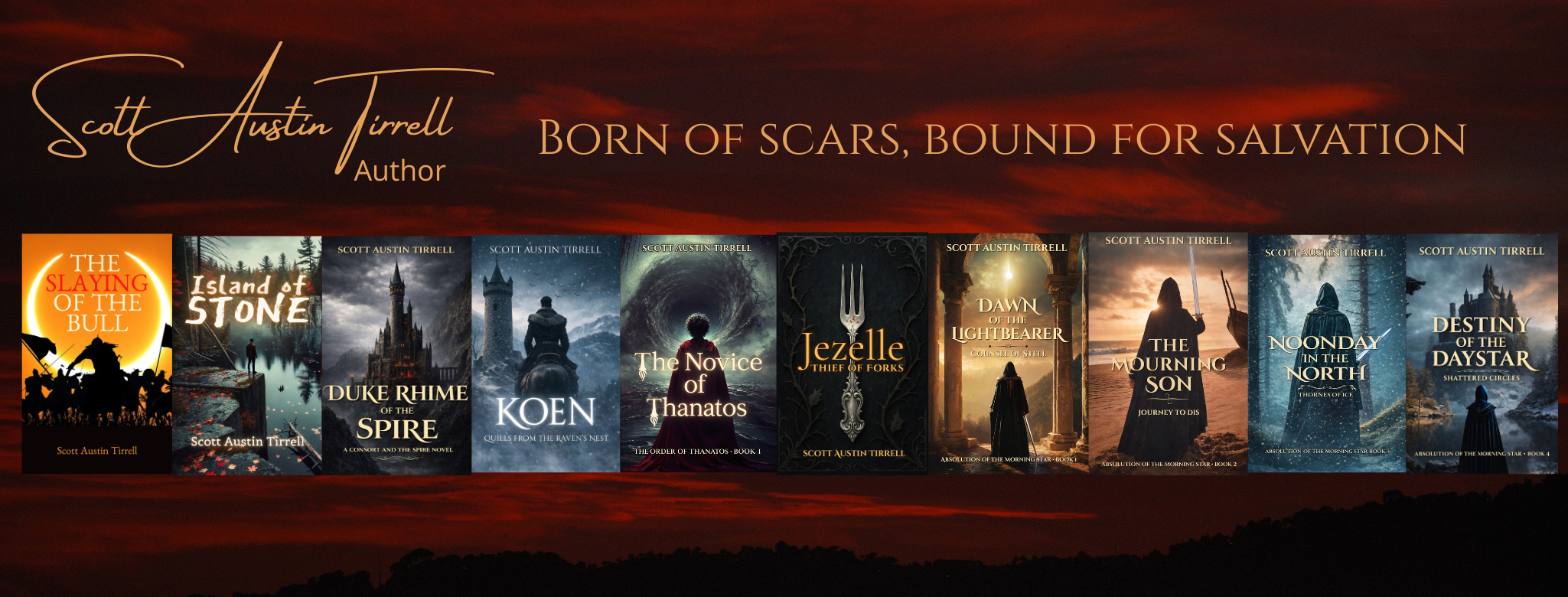
Some have asked how the Island of Stone came to be.
My first few books were hefty on research. I had to delve into Nazi history and secret organizations for my first novel ever, titled Vril. For the Land In-Between, it was religion and demonology. For Slaying of the Bull, medieval Europe, Mongolian history and culture, and the Manichean faith. I also worked on a Sci-Fi mystery book during this time set on the Saturnian moon of Titan. All of these books took a lot of research. I mean, just a tremendous amount of research. We’re talking binders full of all sorts of things.
It might not be inherently clear, but any book requires quite a bit of research. The story flows until you get to a point where you are unsure if you’re accurate. Some simple oversight or inaccuracy can turn off some readers and pull them out of the story. As a writer, that is something you want to avoid at all costs.
A lot of that research never ends up in the final book. For example, I spent a great deal of energy researching Mongolian history and culture for the Slaying of the Bull. I had whole chapters drafted on the Mongolian perspective, with a main character being Batu Khan, who led the invasion into Hungary. They were good, rich chapters, and I developed complex, historically accurate albeit mostly fictitious characters in Batu Khan and his lieutenants. But, as the book progressed, it became clear to me that adding this humanity to my antagonist took away the scariness of the book. I needed to write the villain from the Europeans’ perspective, those that huddled in fear at the approach of this dark horde. To have success in that enterprise, the Mongolians needed to be essentially a mystery. In the 13th century, the Mongolians were virtually unknown to Europeans and even referred to as the Tartars, a completely different culture and people that the Mongolians subjugated. At first, the Kingdoms of Medieval Europe thought the Mongolians were merely raiders and therefore not a threat. The first fingers of the army were much like raiders, but in actuality, they were testing the might of the Europeans, and they were not impressed. The arrogance and naivete of the Christian Kingdoms almost added them to the growing list of civilizations that fell under the sword of the Mongolian empire. The Mongols decimated the Hungarians at the Battle of Mohi. At the time, the Hungarian kingdom could field the most powerful and advanced army in Europe.
In any event, after writing these books, I was a bit worn out on the research front. I wanted my next book to be a simple stream-lined ghost story. I tried to keep the characters minimal and the setting something familiar. The Island of Stone rose from this desire. Although the story grew to be more complex than initially intended, simplicity and minimal need for research were the catalysts behind the book. I love nature, and I’m fascinated by isolation within its bosom. A small quaint cabin on an island deep in the wilderness seemed like a great place to have a ghost story. Throw some ruins on that island and some history, and you have the building blocks for a great setting. Then, take a conflicted man full of grief and put him on said island, with no easy way to escape, and you have a character that can be tested both mentally and physically. Hence, Island of Stone was born.
Cheers!
Discover more from Author Scott Austin Tirrell
Subscribe to get the latest posts sent to your email.

I can only imagine the depth of research needed for some novels. Thanks for explaining your process. I can see how hard it is to decide what to include or exclude.
When I started blogging for my own recovery from PTSD, I never had any thoughts about someone reading my words. The posts sat with no one responding. They were for me anyway. Now I enjoy being part of the community and interacting with bloggers.
LikeLiked by 2 people
I certainly agree. I enjoy going back to my first blogs to see where I was at the time. It has been quite the journey.
LikeLiked by 2 people
Keep up the hard work, if I wasn’t so busy editing and writing myself I would read all you’ve published so far.. I’m slowly getting there though
LikeLiked by 2 people
Thanks! good luck with your current projects.
LikeLiked by 2 people