
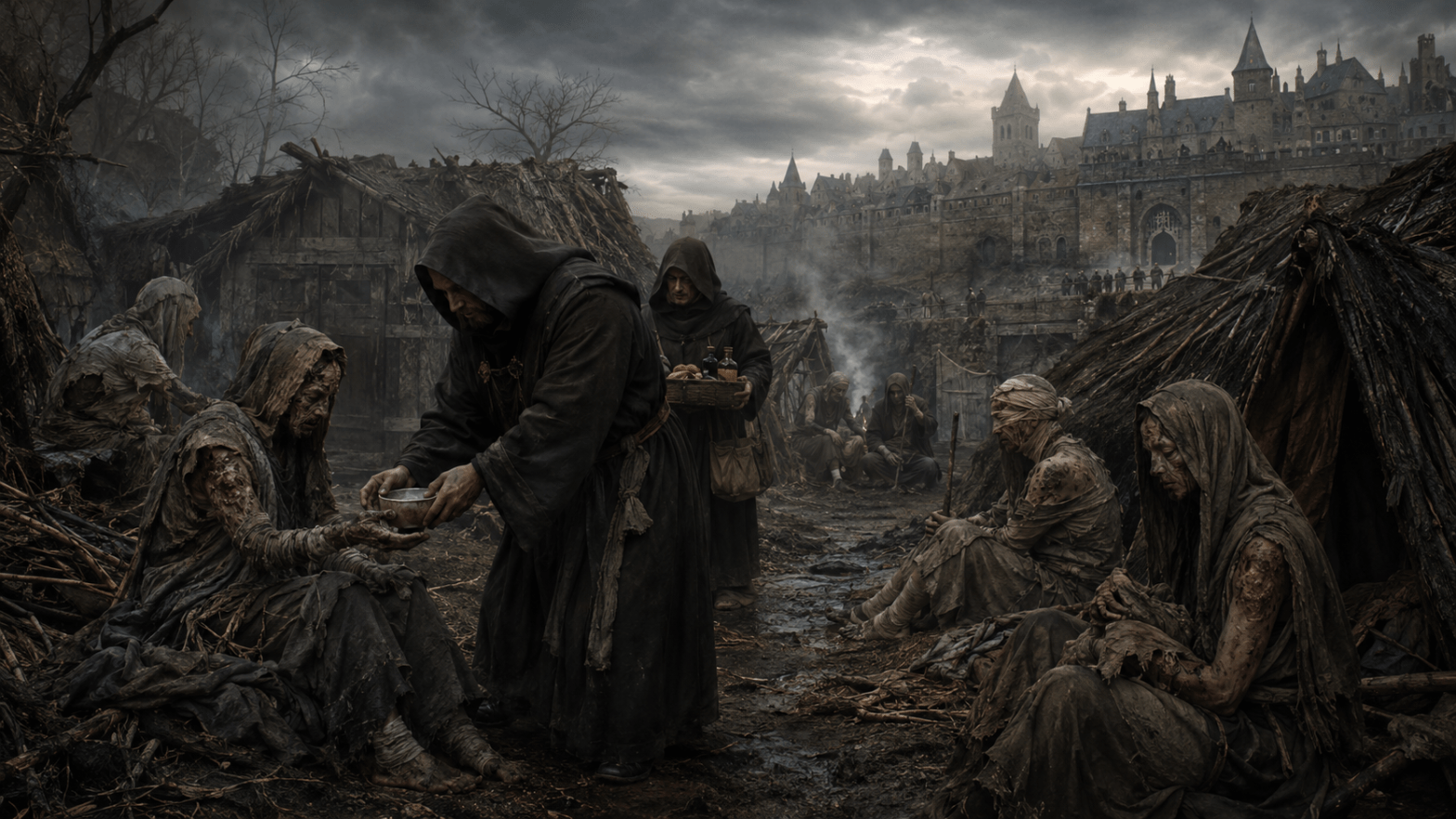
In my world of Lucardia, not every horror announces itself with claws, teeth, or a sword drawn in the dark. Some horrors arrive slowly. They creep beneath the skin. They fester. They deform. They turn a human face into something others cannot bear to look upon. They take years to kill, and before death comes, they steal other things first: sight, fingers, limbs, dignity, family, place, name.
The Creeping Cankers are among the most feared afflictions in my world. It appears in most of my Lucardian books, and soon it will rear its terrible head in Sylvanus: Sword and Sons. To most people in Lucardia, the Cankers are understood as a disease. A terrible one. A disfiguring one. A fate worse than the Blue Sickness, because that plague comes like a storm and passes like one. It burns through villages. It kills quickly. It leaves grief behind.
The Cankers linger.
They mark a person. They announce suffering publicly. Worms move beneath the skin. Sores open. Flesh rots. A smell follows the afflicted wherever they go, and that smell becomes part of the judgment placed upon them. People recoil. Doors close. Children are pulled away. Bread is tossed rather than handed over. All dignity is lost.
The afflicted are pushed to the edges of villages, towns, and cities. They gather in colonies out of necessity. There, on the periphery of the living world, they survive as best they can. They become a people apart, not because they chose separation, but because fear made a border around them. And fear is rarely satisfied with ignorance alone. Fear wants an explanation, even if it’s little more than imagination.
So Lucardians explain the Creeping Cankers the way people often explain suffering when they cannot bear the thought that the world may be unjust. They call it punishment. They call it the fruit of sin. They say the afflicted must have broken vows, betrayed kin, consorted with witches, offended the gods, lived uncleanly, or hidden some secret corruption of the soul.
It is easier to believe the Cankers deserve their suffering. That lie protects the comfortable.
If the afflicted are guilty, then the healthy are safe. If illness is punishment, then wellness becomes proof of virtue. If the Cankers are deserved, then no one has to confront the more terrifying possibility: that pain may come for the innocent, that the world is not always morally legible, and that cruelty can disguise itself as judgment.
The inspiration for this is not purely fantastical. The Creeping Cankers draw from the long and painful history of leprosy, especially as it was understood in the medieval world. Leprosy was not merely treated as an illness of the body. It became an illness of meaning. Visible disfigurement invited spiritual explanation. Sores, damaged limbs, blindness, and bodily decay were read by many as outward signs of inward corruption. The body became evidence in a trial of the soul.
Medieval lepers were often pushed to the margins of society. Some lived in leper houses or colonies outside towns, supported in part by religious charity but also separated from ordinary life. That separation was sometimes framed as mercy, sometimes as public safety, and sometimes as spiritual necessity. Whatever language surrounded it, the result was often the same: the sick were made into a people apart, to suffer and die out of sight.
That history matters to me because it exposes one of humanity’s cruelest instincts. When suffering is visible, people often try to make it legible. They want it to mean something. They want the wound to explain itself. And if they can make suffering into punishment, then they do not have to confront the possibility that pain can be undeserved.
The Creeping Cankers are my dark-fantasy transformation of that fear. But the truth of the Creeping Cankers is worse than the superstition.
The Cankers are not a common illness. They are not contagious in the way people believe. They are not like the Blue Sickness. It is a dark, magical infliction, a weapon cast into the world by an unknown force to weaken opposition and remove those who might stand against an evil plan.
And that is the cruelest turn in Lucardia, the Cankers often find the pure of heart. The same people most likely to help the afflicted are the ones most likely to become afflicted themselves. A monk of Thanatos who tends the dying. A healer who refuses to turn away. A neighbor who still brings food. A daughter who washes her father’s sores. A good soul who cannot bear to leave another human being alone in rot and darkness, and who comes close out of mercy. Then, in time, they feel the itch beneath their skin.
To the world, this proves the disease spreads by touch. It confirms the fear. It strengthens the old lie. “See,” people say, “even kindness cannot save you from corruption. See, the Cankers pass from body to body. See, the afflicted are dangerous and must be cast aside.”
The Cankers are not merely an attack on the body. They are an attack on goodness. They take those who might resist evil and make them objects of disgust. They transform compassion into suspicion. They make the merciful appear cursed. They turn the pure into warnings. The craft is as ingenious as it is cruel.
It turns the suffering into scapegoats. It gives the cruel a theology. It gives the frightened an excuse. It allows towns to shun and call it righteousness. It allows families to disown their own blood and tell themselves they are protecting the innocent. It allows property to be taken, names to be blackened, and entire colonies of the sick to be treated as if they are already dead. It perpetuates the darkness.
The Creeping Cankers reveal something ugly about Lucardia, and maybe about any world built on fear: people would rather believe in a just punishment than an unjust wound. Because if the wound is unjust, then mercy is required. And mercy is dangerous.
This is where fantasy becomes useful to me as a writer. A magical disease does not have to be only a piece of lore. It can become a way to examine the stories people tell about illness, poverty, deformity, exile, and blame. It can ask why societies need scapegoats. It can ask why visible suffering so often becomes moral evidence in the eyes of the comfortable.
The Creeping Cankers are feared because they are ugly. But the greater ugliness is not in the afflicted. It is in the people who look at suffering and decide it must be deserved.
And perhaps that is why this dark magic works so well. Humans are fearful creatures, and this craft thrives on fear. It depends on people confusing purity with corruption and mercy with infection. The worms eat flesh. The lie eats everything else.
Cheers!
Discover more from Author Scott Austin Tirrell
Subscribe to get the latest posts sent to your email.

The writing is wonderful. The insights into what it is to be human are better. Thank you!
LikeLiked by 2 people
Thanks!
LikeLike