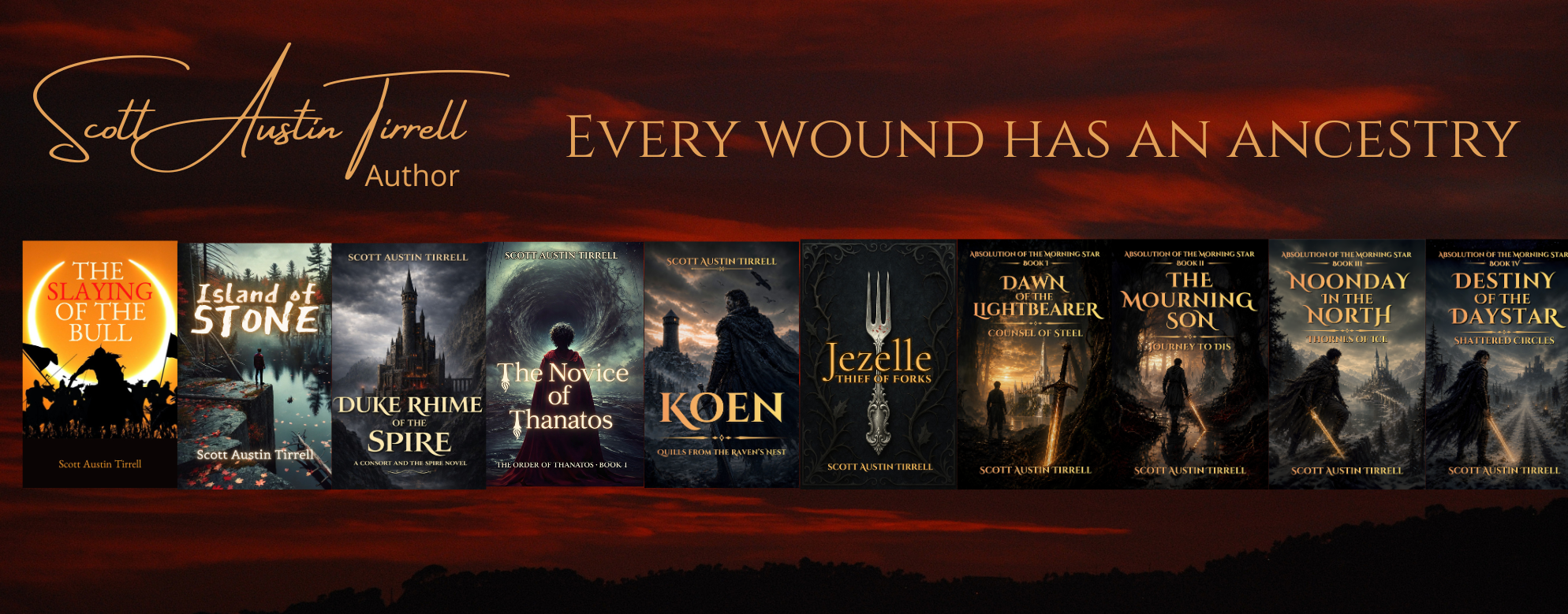
In May of 2021, I published Dawn of the Lightbearer.
In a sense, it feels so long ago, but in another, it was like yesterday. So much has happened since. Lucardia expanded into eight books, with two more on the way (reached 50K words in Sylvanus). But five years later, Dawn of the Lightbearer still feels like the place where Lucardia opened.
It is not where Lucardia begins. That distinction matters. The world reaches back long before Erik enters the story, some four thousand years before. There are old wars beneath the soil, old bargains buried inside the faith, old bloodlines still shaping the living. Koen: Quills from the Raven’s Nest tells part of the story through Erik’s father, and soon Sylvanus’s tale will carry that older generation forward even more. Jezelle: Thief of Forks takes place immediately before Dawn of the Lightbearer, serving as an origin story for one of the most important figures in the Absolution of the Morning Star series, and The Novice of Thanatos and Duke Rhime of the Spire are connected but separate paths.
So there are other doors now.
You could begin with Jezelle if you want the timeline to start just before Erik meets her. You could step backward into Koen, if you want to understand something of the father who shaped the world Erik was born into. Soon, Sylvanus will offer more of that tangled history.
But if someone asks me where to start, my answer is still simple. Start with Dawn of the Lightbearer.
That is where Lucardia became more than fragments in my head. More than old notes, strange names, half-formed myths, and scraps of history. It became roads and hunger. It became faith and danger. It became a boy and a sword no one should have trusted so easily.
That was the first true doorway.
I have always loved fantasy worlds that feel older than the stories told within them. Worlds where roads were built by the dead, where churches preserve lies as carefully as scripture, where noble houses carry rot in their foundations, where the songs people sing about old victories leave out the bloodiest parts. I wanted Lucardia to feel that way. Not explained into neatness. Not flattened into lore. I wanted it to feel lived in, wounded, beautiful, and dangerous.
But a world like that needs a human entry point, and that was Erikson Gray.
He does not begin as a polished hero. He is young, uncertain, and unprepared for the size of the thing moving toward him. He does not understand the sword. He does not understand the faith that surrounds it. He does not understand the shape of the story he has been pulled into. Not even what he knows about his father is true. That is part of why he works as the first guide through Lucardia. He enters the world’s deeper mysteries beside the reader, not above them.
Fantasy often asks its heroes to become symbols. I have always been more interested in what that costs.
What does it mean to inherit a myth before you understand it? What does it mean to carry a light when the shadows around it are older than anyone admits? What does it mean to be handed a holy weapon in a world where holiness and violence have never been cleanly separated?
That question sits at the heart of Dawn of the Lightbearer.
A sword is not a new device in fantasy. In truth, it has defined the genre in many ways. It usually gleams. It should cut. It often gives the hero or heroine their teeth.
But I have never quite trusted swords. A weapon remains a weapon, even when prophecy is wrapped around the hilt. Perhaps especially then. From the beginning, Lightbearer was never meant to be a beautiful, divine weapon. It was meant to carry the weight of a bargain. Something worshiped before it was understood. Something that could save and condemn in the same stroke.
What if the thing people revere is not what they think it is?
What if the story everyone inherited is incomplete?
What if the light is real, but so is the lie beneath it?
What if Humanity’s greatest triumph is also its most dirty secret?
Those were the questions that first opened Lucardia for me. Five years later, I am still following them with no end in sight.
I don’t want this post to overshadow the importance of Jezelle: Thief of Forks, my most recently published work, and the one I so desperately want you to read.
For many readers, Jezelle is the spark in Dawn of the Lightbearer. She arrives already sharpened by a life Erik does not fully understand. She is clever, wounded, dangerous, funny, guarded, and far more important to the Absolution of the Morning Star series than she first appears. She brings the street into the myth. She brings hunger, suspicion, quick hands, and quicker judgment. She knows what the world does to the unprotected because she has survived it.
When she first steps into Erik’s life, I knew she had a past. I knew her humor had teeth because it needed them. I knew she had been hurt, and that she would not surrender that hurt easily. What I did not know yet was how much of Lucardia would eventually open through her. How important she would become to the story, but more importantly, to Erik. I never intended for her to be a viewpoint character, but by The Mourning Son, she had stolen some of the light.
Jezelle’s origin story takes place immediately before Dawn of the Lightbearer. It shows who she was before Erik met her, what she endured, what she learned, and how she became the thief who steps into the larger myth beside him. It can be read first; it was designed to fit in the place if that is how a reader finds me. But there is also something powerful about meeting Jezelle in Dawn of the Lightbearer, with her secrets intact, then going back to learn what those secrets cost.
That is one of the pleasures of a growing world. There is the order of events, and there is the order of revelation. They are not always the same.
Looking back on Dawn of the Lightbearer now, I can see the seeds of almost everything that followed. Caspia. The Nyth Cigfran. The Nephilim. Lightbearer. The burden of old faith. The danger of inherited stories. The uneasy line between salvation and control. Erik’s path. Jezelle’s shadow. The sense that Lucardia was never going to be a clean place, or a safe one, or a world where light and darkness could be kept politely apart.
I can also see the younger writer who made it.
Every writer knows this feeling. Time changes your eye. You become sharper. Less forgiving. More patient. More suspicious of your own easy answers. There are sentences I would handle differently. Scenes I might deepen with all I know now, with what has come after. Shadows I might let linger longer before naming them. Better set-ups, or maybe loser plotlines.
But the seed was true, and that matters more to me than perfection.
The world was there. Not all of it. Not yet. But enough. Enough to open the first road. Enough to bring Erik and Jezelle together. Enough to make Lightbearer gleam in a way that felt both wondrous and dangerous. Enough to suggest that the oldest stories in Lucardia had not finished telling the truth.
Everything since has grown from that seed.
The Lucaridan world has become stranger, darker, and more complicated than I could have imagined since I put the first words of Lightbearer down during the peak of COVID’s isolation. Characters who once stood at the edges have stepped forward. The dead have grown louder. The past has become less willing to stay buried. Other books now reach before and around Dawn of the Lightbearer, filling in origins, bloodlines, wounds, and consequences.
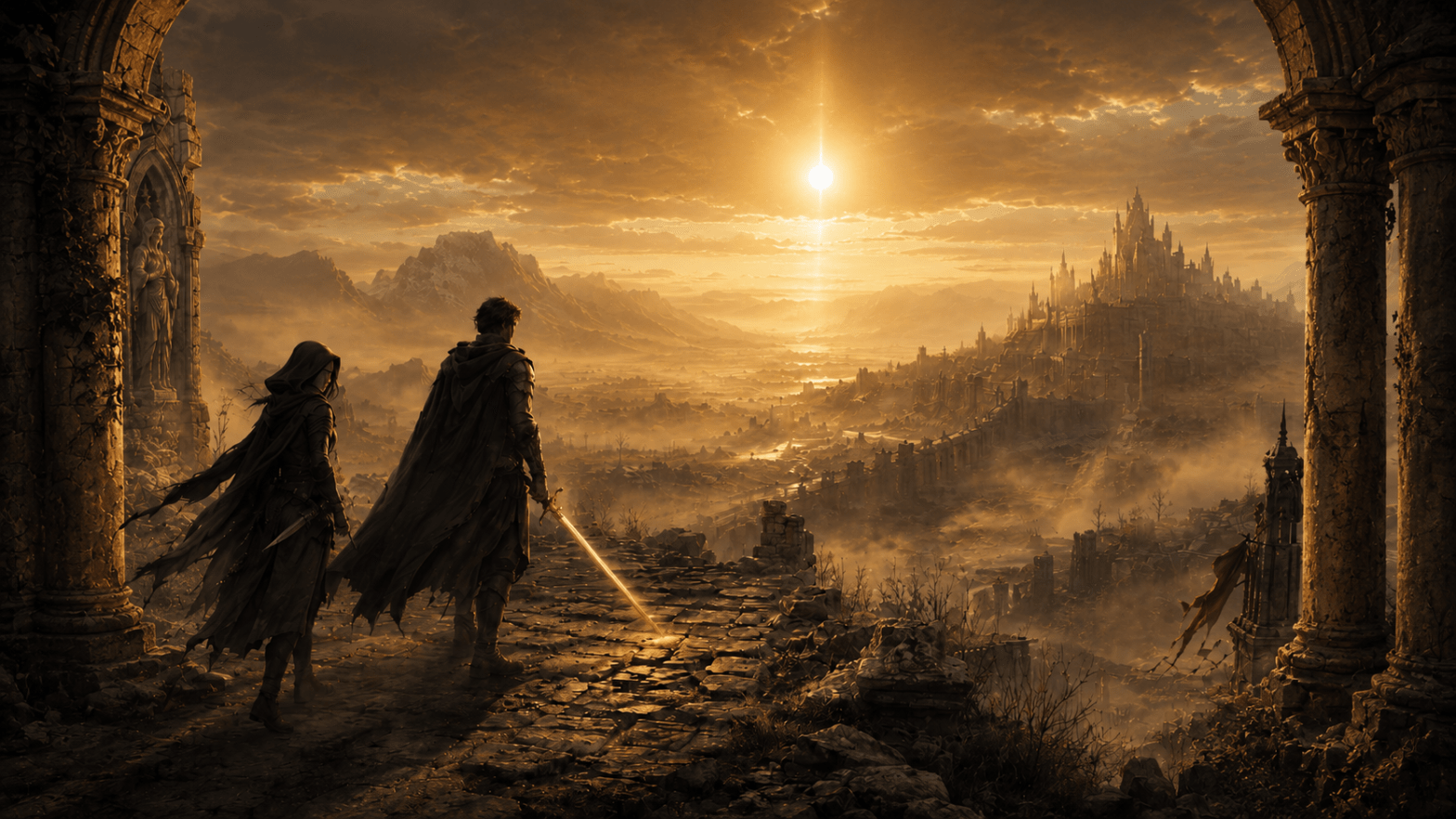
But Dawn of the Lightbearer remains the first door. If you have never entered Lucardia, that is still where I would hand you the key. Start with the blacksmith apprentice with the grander destiny. Start with the sword bright enough to cast a very long shadow.
And if you have already read Dawn of the Lightbearer, I would love to hear from you. What stayed with you from that first journey into Lucardia? Erik? Jezelle? Wendell? Lightbearer? Caspia? The monsters? The myths? The lore? The feeling that something old and dangerous was moving beneath the story? Did you begin with Dawn of the Lightbearer, or did you come into Lucardia another way?
Leave a comment and tell me.
Five years later, I am still grateful for that first door—and for everyone who stepped through it. Dawn of the Lightbearer is still alive, still eager for eyes. It may have gotten harder to see the door in the mist and hustle, but it opens to a marvelous place. That I can guarantee.
Cheers!
Discover more from Author Scott Austin Tirrell
Subscribe to get the latest posts sent to your email.

I started there. What stayed with me, above all, was Lucardia the world. It was more the world I wanted to reenter that kept me coming back than the characters or the plot line. Jezelle and Wendell were likely the most interesting characters to me, if I think back…
LikeLiked by 1 person