All cities are hungry.
That was one of the first truths I came to understand while writing Grafton Notch. A city is not merely streets, walls, markets, alleys, and gates. It is appetite made physical. It is what people want, what they are willing to do to get it, and what happens to those who stand in the way. Some cities hide that hunger beneath ceremony, law, faith, wealth, or pretty facades. Grafton Notch does not.
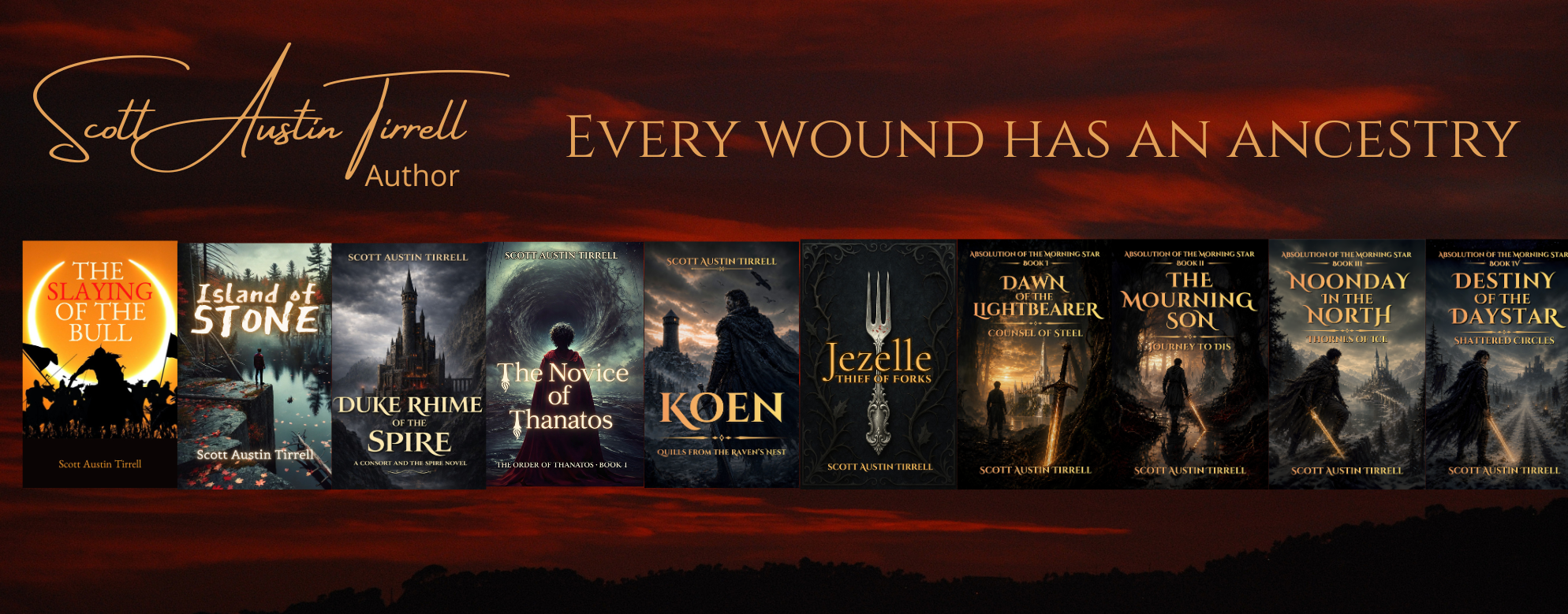
I had spent some time in Grafton Notch before. It is where Dawn of the Lightbearer begins, but in Jezelle: Thief of Forks, I became immersed. I knew the city had to be more than a backdrop. Most of the story takes place there, and if the reader was going to remain in one place for so long, that place needed to breathe. It needed moods, layers, wounds, secrets, and contradictions. More importantly, it needed to act upon Jezelle. Grafton Notch could not simply be where her story happened. It had to be one of the things that shaped her; in other words, if she had stayed in Oakenyard, she would have become a different person. Grafton Notch had to change her weave, her destiny—and it did.
I wanted the city to feel dark and gritty, not in a decorative sense, but in a lived-in one. This is a medieval world, and Grafton Notch sits on the fringe of an empire, far enough from the center that law feels distant, and opportunity has sharper teeth. It is not an ancient capital with centuries of ritual and polish behind it. In the scheme of Lucardia, it is new, only about sixy years old, closer to a colony than a grand imperial city. But its growth has been fast and dirty, and just because it is new does not mean it is innocent. Grafton Notch is also built on ancient bones, an old bad memory that it feeds upon.
That contradiction became central to how I imagined the city. On the surface, it is young, raw, and opportunistic, a place still forming its identity through trade, blood, and ambition. Beneath it, there is something older. The nearby Acheron forest carries its own curse-haunted charge, and the hills around the city hide tunnels and ruins that predate the walls raised above them. Grafton Notch may be new in name, but the land remembers things the city would rather not understand. The dirt it has sunk its roots into is rich with rot.
For me, that is where a place begins to become a character. Not because it has a map or a name, but because it has contradictions. It has a face it shows the world, and something buried underneath. Like people, cities are multifaceted; they lie about themselves.
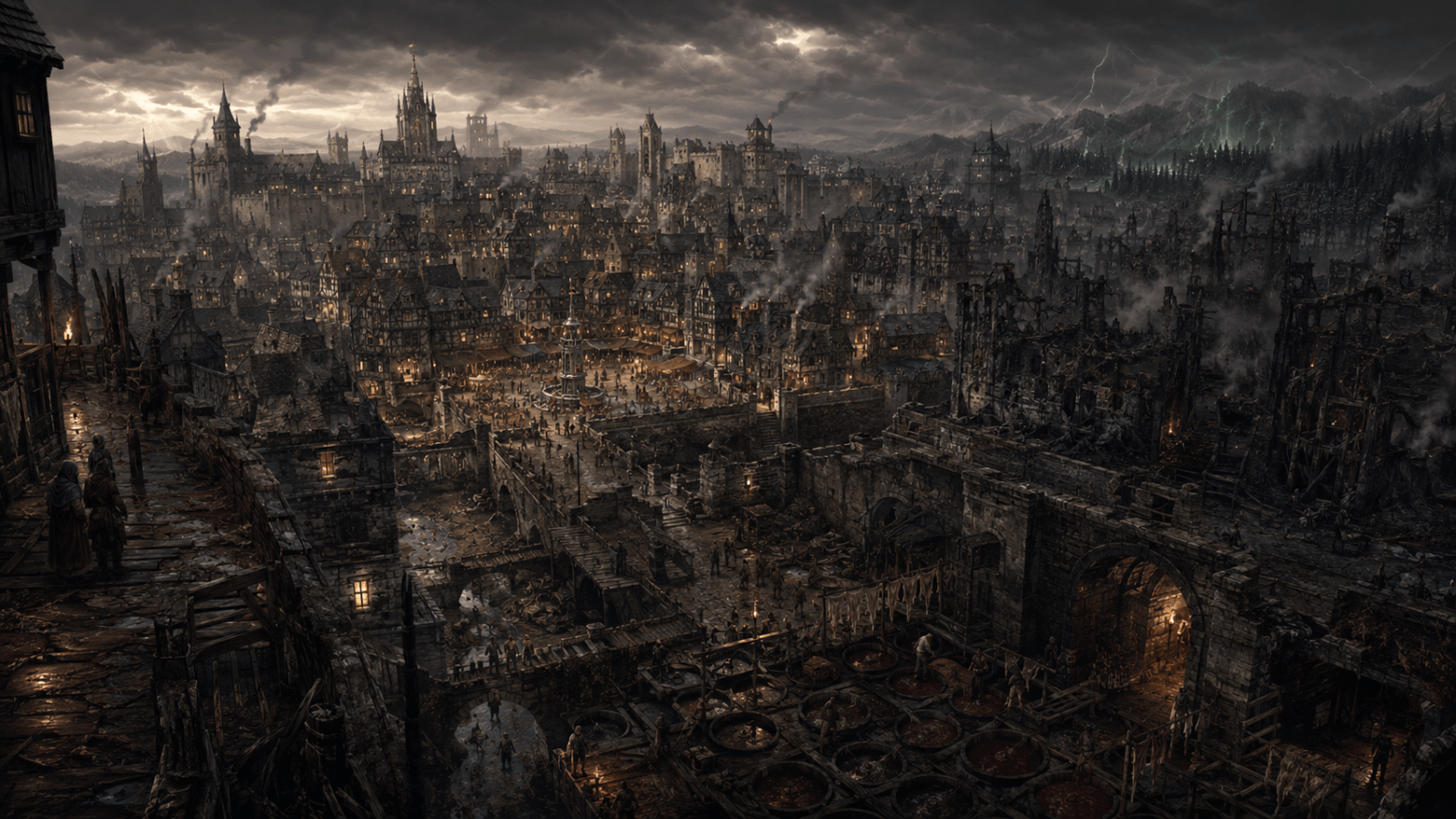
Grafton Notch tells one story through trade. It is primarily a fur city, fed by trappers, skinners, tanners, laborers, and the merchants that bring it all to market. To feed the fur industry, there is a myriad of other efforts to support it, such as blacksmiths, ferriers, wheelwrights, coopers, trap makers, etc. Then, you have the taverns, inns, and brothels for people to go after work, and those who suckle from the hard work of others. They are all looking to make money far from the Empire’s watchful eye. The fur industry has its section, and the supporting industries branch off from it. Amicus Square sits at the heart of it all, where commerce, gossip, ambition, and desperation gather in the same crowded breath. The Caspian Church has its cathedral, the iron workers have their district, the rich have their walls and gardens up on the hill. The streets are the arteries, and the tunnels are the veins. The southern gate brings in the furs. The western gate sends goods toward Bleakwharf and the ports beyond.
On the surface, it is industrious and thriving. But fur is not a gentle trade. It is blood, traps, knives, skins, salt, rot, stink, and profit. It is grizzled men stumbling in from the forest after weeks or months free from the shackles of society. That kind of economy shapes a place. It teaches people what is rewarded. In Grafton Notch, the reward goes to those willing to take risks, endure filth, exploit weakness, and look away when looking too closely could cost them.
This is why the city’s underworld matters so much. Crime does not thrive in Grafton Notch by accident. The government is weak. The Empire is distant. Money moves through the streets, but not cleanly. Vice is tolerated. Desperation is common. People arrive looking for work, pleasure, protection, escape, or power, and the city provides opportunities for all of it, honest and otherwise. But mistakes are felt, and felt hard. Grafton Notch is the sort of place where an ambitious person can build an empire one moment, and a tomb the next.
This matters when building a city as a character. The economy cannot be a mere background. It should tell the reader what the city values. Grafton Notch values opportunity, but opportunity in its most brutal form. It asks what a person is willing to do, then rewards the ones willing to do what others can’t or won’t.
Jezelle enters this world from the bottom, and that perspective changes everything. The reader does not first see Grafton Notch through a noble, a merchant, a soldier, or a priest. The reader sees it through the lens of an abandoned child. That makes the city feel larger, crueler, and more intimate. Its dangers are not political abstractions. They are immediate and bodily. Hunger. Cold. Filth. Men watching too closely. Doors that do not open. Streets that offer no mercy.
Grafton Notch is not uniquely cruel because it is full of monsters. It is cruel because it behaves like a city. It sorts people by usefulness. It protects those with money, strength, or leverage, and it consumes those without them. Children are not sacred there. They are the weakest and easily become labor, burden, prey, or opportunity, depending on who is looking at them. There is no sentimental protection waiting in the streets.
What mercy exists comes from people, not systems. That distinction matters. Grafton Notch has laws, trade, taxes, gates, and institutions, but none of those are designed to save a girl like Jezelle. The moments of grace she finds come from other wounded people, from those who understand the city’s teeth because they have felt them too. That keeps the city from becoming one-note. It is brutal, but not empty. It is predatory, but not without refuge.
A city that is only cruel becomes flat. A city that is only filthy becomes dull. Darkness needs contrast, or the reader stops feeling it. Grafton Notch has brutality, but it also has pockets of shelter. Not safety exactly, because safety is too generous a word for what the city offers, but places where the teeth do not immediately close. An abandoned building. A shadowed corner. A tunnel. A friendship. A moment to breathe.
The city’s layers helped me keep it alive. There is the visible city of Amicus Square, gates, taverns, brothels, tanneries, and markets. There is the wounded city of the Gutters, the older district devastated by fire and never rebuilt. And there is the hidden city beneath the streets, where mining passages intersect older tunnels connected to ruins in the surrounding mountains. Jezelle spends much of the book moving through these buried places, and they matter because they reveal that Grafton Notch has a public face and a secret body.
I often think of Amicus Square as the heart of the city, with its proud statue of the city’s founder. The gates are its throat. The Gutters are scar tissue. The streets and tunnels are its circulatory system, and then there is something deeper, the bowels where the shit settles. That may sound grotesque, but cities should be a little grotesque, especially in dark fantasy. Real cities have waste. They have smells. They have beautiful facades and places everyone pretends not to see.
Smell became especially important for Grafton Notch. I know I am naturally a visual writer, so I make an effort to dwell in the other senses. In dark fantasy, that is important because darkness doesn’t lend itself well to the visual world. I’ve exhausted the thesaurus for the lack of light. Grafton Notch is not always a place seen, but breathed. It stinks of drying pelts and skins, tannery runoff, dung, smoke, sweat, wet wool, stale ale, old yeast, damp wood, and too many bodies pressed too close together. There is the wiff of old fire that still drifts from the Gutters. There is the smell of freshly baked bread. There is the belch of the old canals, and the fresh wetness of the river. A breeze from the Acheron might cut through it all, carrying a sense of wildness from the forest beyond the walls, and when the wind blows from the west, the sea.
Those contrasts matter. The city is foul, but it is not dead. It is hell pressed against the divine. Slaughtered meat and baked bread. The stink of tanneries and the breath of nature. One reminds the reader of labor, commerce, and bodies. The other reminds them that Grafton Notch is not as civilized as its walls pretend.
All of this shapes Jezelle. The streets teach her before any mentor does. They teach her to watch, to hide, to listen, to move lightly, to recognize danger, to take advantage of opportunity before it disappears. They make her thin, sinewy, quick, and hard to catch. Hunger sharpens her. Fear trains her. The city teaches her to stay small, but not weak. Grafton Notch wounds Jezelle, but it also gives her tools. It teaches her theft before she understands theft as a craft. It gives her enemies, friends, secret paths, and scars. It gives her the knowledge of how people look past what they do not value. It shows her that being overlooked can become a weapon.
That, to me, is the real work of place in fiction. A city should not sit quietly behind the characters. It should press on them. It should leave marks. It should have a smell, a hunger, a history, and a shadow. It should offer doors and demand a price for opening them. If the story could be moved somewhere else without changing the character, then the city has not yet done enough.
Grafton Notch had to do work. It had to explain why crime could flourish, why innocence could be bartered away, why a child could be broken down, and why that same child might also be sharpened into someone capable of surviving it. It had to feel rich enough that the reader would not grow bored remaining there, but dangerous enough that no refuge ever felt entirely safe.
That is why cities matter to me. They are not containers for a story. They are forces within it. They compress the human experience into streets and walls: wealth, hunger, lust, faith, violence, mercy, ambition, rot, and hope squeezed until one bleeds into the next. They bring people close enough to wound one another, to need one another, to use one another, and sometimes to save one another.
Grafton Notch is not where Jezelle was born, but it is where she is made. It leaves marks on her body and her soul. It makes her wary, quick, hungry, and hard to kill. The city is cruel, but it is also instructive. It is a predator, but also a teacher. It is a wound, but also a forge.
Grafton Notch is hungry.
So Jezelle learns to hunger back.
Cheers!
Discover more from Author Scott Austin Tirrell
Subscribe to get the latest posts sent to your email.

I like your use of PLACE to name this element of fiction. Although it is commonly understood as included in SETTING I have never liked that term as to me it signals a lack of primacy, making it more of a backdrop, scenery that can be just sketched in or more richly painted but that (unlike Birnam Wood) doesn’t move, doesn’t shape the plot, can’t bring down a king.
LikeLiked by 2 people
I think fantasy writers often understand this instinctively because speculative fiction forces place to become active. The world is not assumed; it has to be built, and once you build it honestly, it starts exerting pressure on everything else.
A city with different laws, gods, monsters, economies, climates, magic systems, etc., cannot just sit behind the characters. It changes what people fear. It changes what they want. It changes what power looks like. It changes what survival requires. That is where worldbuilding becomes more than lore. It becomes a way of asking how human behavior bends under different conditions.
That is one of the reasons I love fantasy. At its best, the fantastic environment is not an escape from human truth, but a strange new lens for examining it. Place becomes character because it has agency. It influences the plot, shapes the moral choices available to the characters, and sometimes becomes the very force they are struggling against.
LikeLiked by 2 people
Writer as sociologist / social psychologist!
LikeLiked by 2 people