I have never been very interested in destinations.
That might sound strange coming from someone who writes fantasy, because fantasy is full of destinations. Towers. Cities. Mountains. Lost kingdoms. Temples buried under old stone. A throne that must be reached. A gate that must be opened. A relic that must be found. A monster that must be slain.
But the destination is not really the point.
The destination is finality. It is the period at the end of the sentence. It is where the map stops. The good things, the terrible things, the strange things, the things that change a character forever, those happen along the way.
That is life, isn’t it?
We spend so much of it looking ahead. Waiting for the next thing. The better thing. The place where we will finally understand ourselves. The moment when all the trouble will have meant something. Then, when that moment passes, we look back on what came before it with longing. We call it nostalgia. We remember a day, a room, a season, a face, a road, and we think, I did not know how good that was while I was living it.
And while we are thinking that, we miss another moment.
That is one of the tragedies of being human. We are rarely where we are. We are haunted by the past and worried by the future, caught in a loop of memory and anticipation. The present slips through our hands. By the time we understand what we had, it has already become part of the road behind us.
Maybe that is why I return so often to journeys and quests in my writing.
All stories are journeys of some kind. Even the quiet ones. Even the ones that never leave a room. A character begins somewhere, changes, breaks, learns, fails, survives, and ends somewhere else. The movement may be physical, spiritual, emotional, or all three. Fantasy simply makes that movement visible. It gives the inward road an outward shape.
A man who is lost in himself becomes lost in a forest. A boy looking for purpose finds himself walking through a monastery of stone, blood, silence, and death. A thief searching for freedom runs through a city that would eat her alive if she lets it. A prince fleeing the shape others have made for him crosses borders, woods, sickness, and war, only to find that no road can keep him from himself forever.
That is what fantasy does so well. It turns the soul inside out and gives it weather.
The quest is one of fantasy’s oldest and most familiar shapes, but I do not think a quest works because of the prize at the end. A journey does not always need a prize. A quest does. That is the difference, at least in my mind. The quest has an object, a purpose, a thing to find or recover or destroy. A sword. A crown. A cure. A god. A truth. But the visible prize is rarely the real one. Just like in the real world, the true prize is often hidden from us. It comes sideways, sneaking up in the tall grass.
My characters are almost always searching. Sometimes they know what they are searching for. Often they do not. They think they are searching for safety, vengeance, answers, survival, power, absolution, or escape. Beneath that, they are usually searching for purpose. Meaning. Their place in the weave.
Or better yet, how to free themselves from the weave entirely.
That is where the real tension lives. Not in whether they reach the mountain or find the artifact or survive the battle, though those things matter. The deeper question is what the road does to them. What it reveals. What it strips away. What it leaves behind when the easy answers are gone.
I do not like easy roads. That is probably obvious to anyone who has read my work. My characters suffer. Sometimes terribly. I do not do that because I think suffering is noble on its own, or because grimness is more honest than joy. I do it because suffering reveals things comfort can hide. Push a person far enough, and something true comes out. It may be courage. It may be cruelty. It may be faith. It may be cowardice. It may be love. It may be a kind of madness. But something comes out.
Dark fantasy lives in that place. It understands that beauty and horror are not opposites. They are often standing beside each other, touching hands. You need shadow to see the light. You need light to see in the darkness. They are joined.
That is how I see landscape, too.
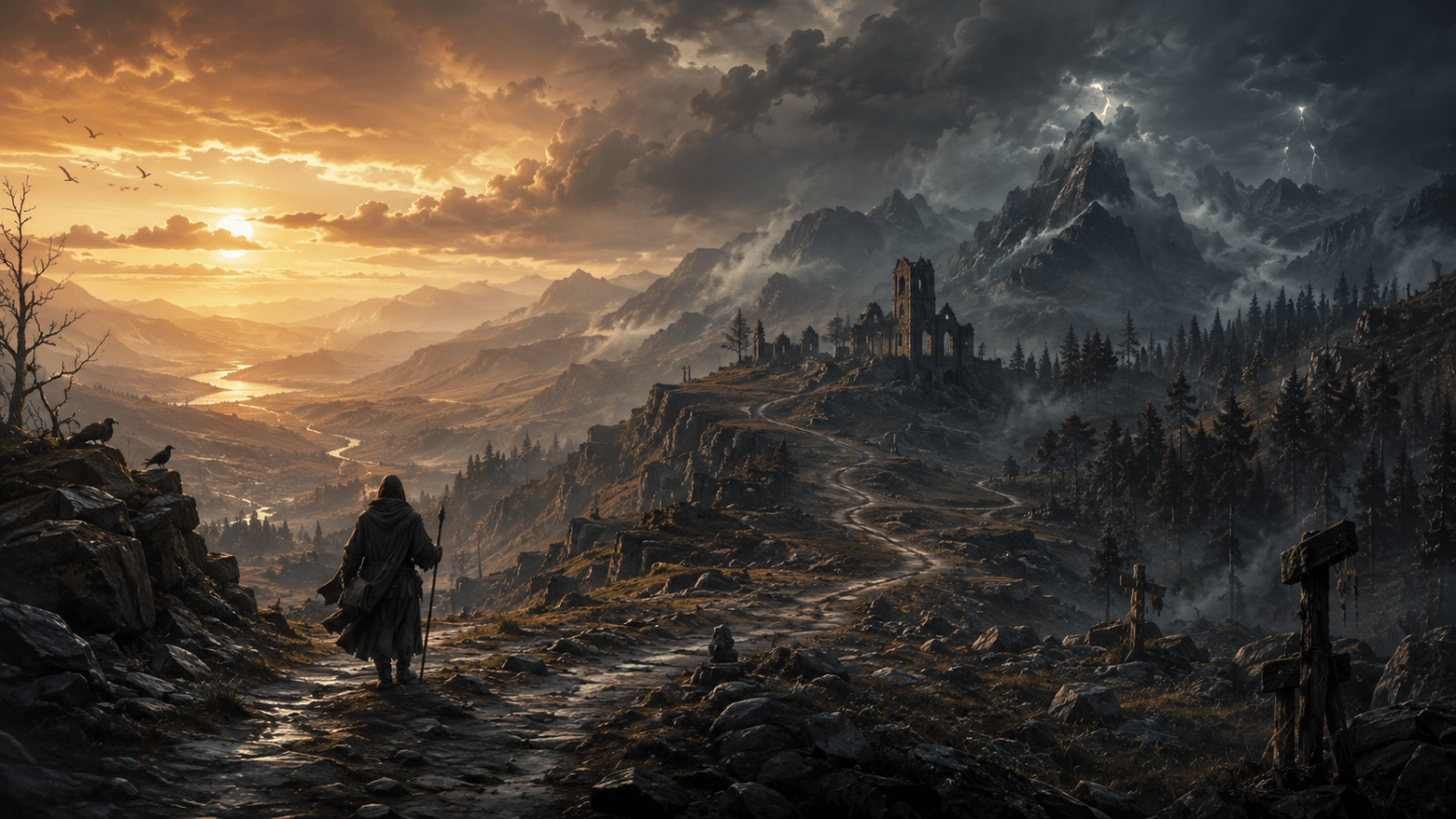
In my last post, I discussed place in fantasy, and how it should never be only scenery. A landscape should not sit politely behind the characters like painted cloth on a stage. It should press against them. Tempt them. Shelter them. Wound them. Change the choices available to them. In fantasy, place has power. It has memory. It has teeth.
I love harsh places. Grim places. Cold places. Cities with rot under the stones. Forests that feel older than language. Monasteries that smell of iron, candle smoke, and old fear. Border towns where every gate has a price. Wastelands that stretch so far that the mind starts inventing ghosts just to have company.
But I also love beauty.
The world can offer warmth, pleasure, joy, and comfort one moment, and kill you the next. That is not a contradiction. That is reality. A sunrise does not stop wolves from hunting. A soft bed does not mean the plague will pass over your door. A field can be golden in the morning and soaked with blood by nightfall. The journey through that dichotomy is the adventure.
It is also, I think, one of the ways we interact with God.
Not always in the clean, doctrinal sense. Not always in the comforting sense. Sometimes it is an argument. Sometimes it is awe. Sometimes it is rage. Sometimes it is a silence so vast that the character has to decide whether it means absence or mystery.
The road asks questions:
Who are you when no one is watching? What do you worship when everything else is taken? What do you become when the thing you wanted costs more than you meant to pay? What if the prize was never the point? What if you reach the end and still feel empty?What if you fail, and the failure saves you?
I do not believe stories are ever truly complete. They may resolve, yes. There may be an ending. A death. A victory. A homecoming. A door closed. A kingdom restored. A body buried. A vow fulfilled.
But resolution is only a moment in time.
The characters existed before the first page, at least in my imagination, and if they survive the book, they continue to exist after the last page. Even death is not always an ending in my worlds. Sometimes death is only another threshold, and perhaps the most frightening one.
That is why I do not mind leaving some questions alive. I hope readers find answers in my words, but questions are just as important. Maybe more important. An answer can close a door. A question can become a road, and another journey.
I’ve said before that when I write, I usually know certain destinations. I know places I want the characters to reach. I know moments I want them to face. I know some of the wounds waiting for them and some of the truths buried ahead.
But I try not to force the path too much.
The character’s evolution determines how they get there. Their choices matter. Their fears matter. Their pride, tenderness, stupidity, courage, and hunger all matter. Sometimes they take the road I expected. Sometimes they refuse it. Sometimes they make a choice that changes the destination entirely.
That is where the magic of writing lives for me. Not in controlling everything, but in listening closely enough to know when the story has become more alive than the outline.
If the road is too easy, then it is my job to put something in the way. A locked gate. A betrayal. A storm. A sickness. A temptation. A death. Not because obstruction is entertaining by itself, but because characters reveal themselves against resistance. They become real when they are forced to choose.
And sometimes those choices kill them.
I have had disagreements with my wife about this. There are characters she did not want me to kill. Characters I did not necessarily want to kill, either. But if the road leads there, and if the choices lead there, then I have to let it happen. As in life, people die unexpectedly. The beloved are not spared because we love them. The good are not protected because they are good.
If it shocks me, it will shock the reader. More importantly, if it feels true to me, I have to honor it.
That may sound brutal, but I do not think it is hopeless. There is hope in the journey itself. There is hope in the fact that a character can change. That they can learn. That they can discover some hidden strength or terrible flaw. That they can stand in a ruined place and still see beauty. That they can find their soul, or their purpose. That they can lose the thing they thought they needed and find something stranger, harder, and more honest in its place.
Not all finding needs to be possession. Maybe sometimes the character does not find the relic, does not win the crown, does not return home, does not become who they meant to become. Maybe instead they find one clear moment of truth. One act of courage. One glimpse of God in the dark. One reason to keep walking.
Maybe that is enough. Or maybe it is not. That is the question I keep returning to.
The road is the story because the road is where we are tested. It is where we are wounded and remade. It is where beauty and terror walk beside us. It is where the past calls from behind and the future waits ahead, and the present, brief and blazing, asks us to notice it before it is gone.
The destination matters. But only because of what the journey makes of us before we arrive.
Cheers!
Discover more from Author Scott Austin Tirrell
Subscribe to get the latest posts sent to your email.

“how to free themselves from the weave entirely” “he deeper question is what the road does to them. What it reveals.” Yes! The usefulness of a quest, like interacting with the external world generally, is to use the reflection that world provides to see oneself and discover that the prize was never out there. It is within, and always has been. A useful comment by Jim Carrey: “I think everybody should get rich and famous and do everything they ever dreamed of so they can see that it’s not the answer.”
LikeLiked by 1 person
““suffering reveals things comfort can hide. Push a person far enough, and something true comes out.” Wayne Dyer agrees! “When you squeeze an orange, you’ll always get orange juice to come out. What comes out is what’s inside. The same logic applies to you: when someone squeezes you, puts pressure on you, or says something unflattering or critical, and out of you comes anger, hatred, bitterness, tension, depression, or anxiety, that is what’s inside.”
LikeLiked by 1 person