There are certain things that keep a writer up at night. Is this character interesting enough? Does this chapter drag? Did I use the word just seventeen times on the same page? And then there is my particular torment:
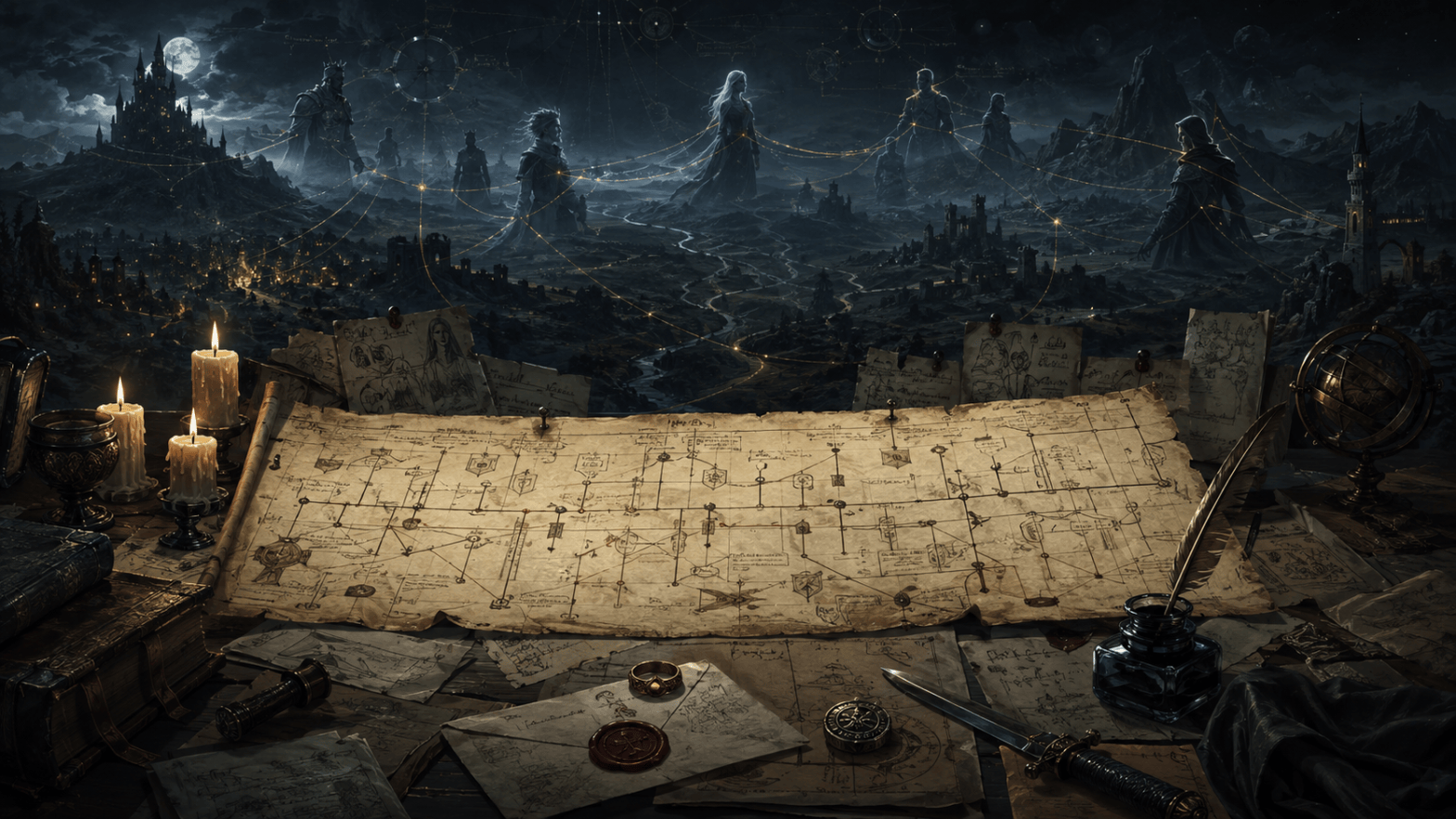
Timelines.
My formal Lucardian Timeline covers roughly a thousand years of recorded history, but once you include the prehistory mentioned throughout the books, the world reaches back more than four thousand years.
Oddly enough, most of the books themselves occupy a very small portion of that enormous history. With the exception of Duke Rhime of the Spire (which takes place hundreds of years before the main arc), nearly everything I have written in Lucardia takes place within a span of only a couple of decades. That compression creates problems.
When two events are separated by three hundred years, there is usually plenty of room to work. A king dies. A war begins. A kingdom disappears. Provided everything happens in approximately the correct order, there is some flexibility. When several novels happen within years—or sometimes months—of one another, that flexibility starts disappearing.
Sometimes the problems are tiny. While editing Sylvanus: Swords and Sons, for example, I realized that a 25th anniversary event I had placed in the very first chapter of the novel didn’t quite line up with the year Queen Constance of Anworth died. The discrepancy came down to the birth year of her son, Eadred, as she died giving birth to him. Fortunately, I had never established Eadred’s precise age in any of the books, so I simply moved his birth year by one year in my master timeline. Problem solved. Nobody will ever know the difference (well, you all do now, but that’s fine).
That is the good kind of timeline problem: a detail hasn’t yet hardened into canon, so I still have room to move it. The difficult problems are the ones where there is nowhere left to move.
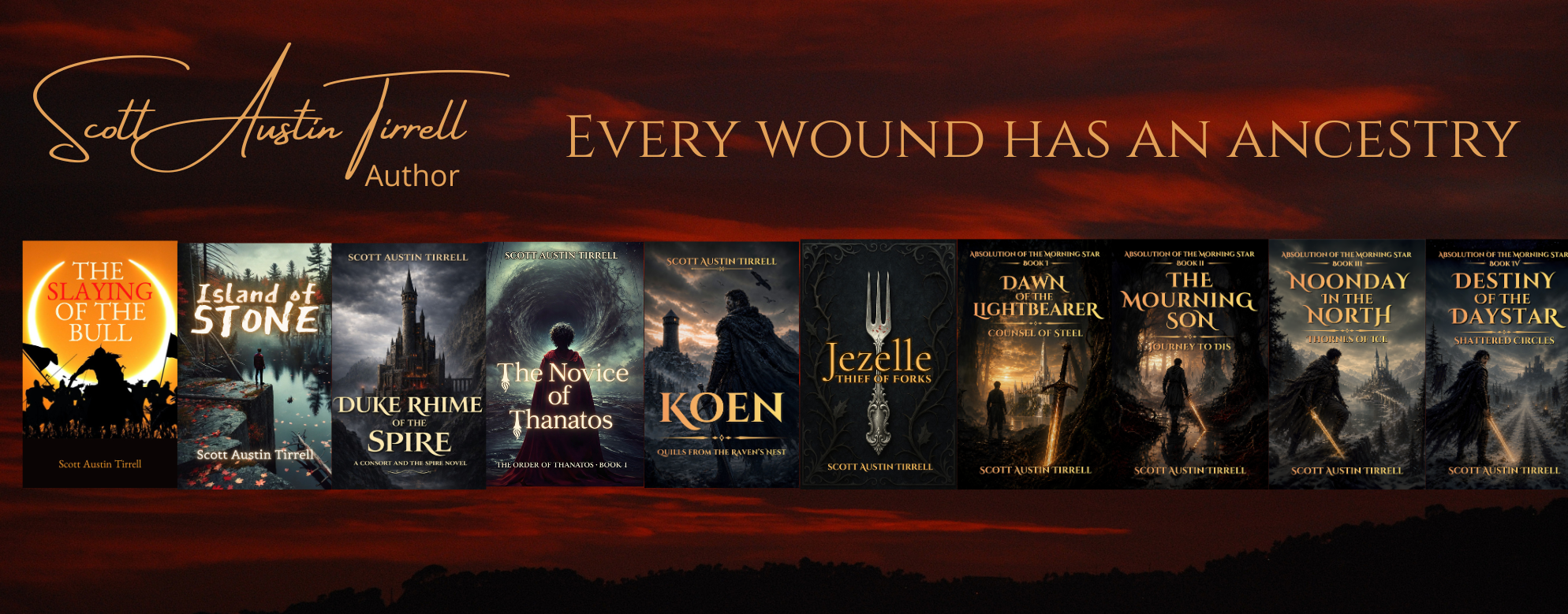
That is what happened with the planning for Erikini. It will be the third book in my Blood and Banners sequence, following Koen: Quills from the Raven’s Nest and Sylvanus: Swords and Sons, and preceding Jezelle: Thief of Forks.
I already know the major story I want to tell. I know Erikini’s journey, the characters involved, and many of the major moments I want the novel to contain. I created an outline I was excited about. Some of that structure was dictated by the already established timeline. It isn’t always a horror. But then a hitch woke me up in the middle of the night, and first thing in the morning, I checked the timeline.
Hard stop.
Nothing in the proposed story was inherently impossible if I had actually written these books in chronological order. The problem was that Lucardia already had a future. Events in Jezelle are established. Events in Dawn of the Lightbearer and the subsequent Absolution of the Morning Star books are established. Characters have known histories, relationships, locations, memories, and circumstances. Those things aren’t suggestions anymore. They’re canon, and I don’t want to change them.
So I couldn’t simply write the version of Erikini that worked best in isolation. The novel had to arrive at a very specific point in Lucardian history, with everything positioned correctly for stories readers may already have read. The question was no longer simply What would make the best story? It became What would make the best story that can actually happen?
That distinction forced me to rethink a substantial portion of the book. I had to change the structure. Events needed to move. Some awesome ideas had to disappear entirely. Certain parts of the story needed more room, while others had far less room than I originally imagined.
The trick was making those changes without letting the timeline become visible in the story. A character shouldn’t suddenly decide to travel somewhere because I, the author, know she needs to be there later. Someone shouldn’t disappear from the narrative simply because another book requires them to be unavailable. The characters still need to make choices for believable emotional reasons, and history has to feel inevitable after the fact, even when I am sitting behind the scenes desperately trying to make everything fit.
It led to an entire day of brainstorming plausible solutions to a multitude of complications arising from an already established timeline. The entire Erikini book had to fit within a narrow time frame, constrained by everything from the duration of Koen and Sylvanus’s war with their father to the ages and histories of characters who appear much later. Changing one part of the outline affected another, and solving one problem could easily create two more.
I can’t even explain some of the hardest pieces to you yet. Some of the connections between Erikini, Jezelle, and The Absolution of the Morning Star involve things readers aren’t supposed to know at this point. There are relationships, identities, and consequences that I have deliberately left for readers to discover in glorious aha moments.
That is part of the strange experience of writing an interconnected fantasy world, especially one I have written in something other than chronological order. I began with Dawn of the Lightbearer. Since then, I’ve repeatedly moved backward into the history that created that story. Characters who once existed only as names or memories have become protagonists. Political events mentioned in passing have acquired causes, consequences, and human beings trapped inside them.
Every time I write one of those earlier stories, I gain freedom in one direction and lose it in another.
I can invent the past, but I cannot contradict the future.
That’s what makes planning Erikini so difficult. I am not writing toward an open horizon. I am writing toward events that already exist. In some ways, the timeline becomes a set of walls around the story, and the challenge is making sure readers never see those walls.
They should simply see Erikini making choices, loving people, hating people, surviving, failing, and becoming the person the story requires her to become. They shouldn’t see me behind her with a calendar and the growing expression of a man who has just realized that something he wrote years ago has made his newest idea impossible.
Most readers will probably never notice whether I get all of it right, and they shouldn’t. Continuity is one of those things that tends to become visible only when it fails. Nobody finishes a novel and thinks, Thank God all those dates lined up. Get one important detail wrong, however, and the illusion cracks.
So I obsess over it. I move dates when I still can. I rebuild outlines when I can’t. I stare at my own timeline wondering why some idiot author made a decision five books ago that is now making my life considerably more difficult, and then I remember who that idiot was.
Somewhere in the back of my mind is the knowledge that every new detail I add today is potentially another trap waiting for me three novels from now. That is why timelines are the bane of my existence—and why I will absolutely continue making them more complicated.
But I promise you as much as I promise myself, it will all be worth it. If I can pull off what I have planned across these two series and ten books, if all those characters, histories, revelations, and seemingly insignificant details eventually click into place, it will be epic.
Cheers!
Discover more from Author Scott Austin Tirrell
Subscribe to get the latest posts sent to your email.

Ten minutes to midnight … That’s when most stories happen.
LikeLiked by 1 person
Yes! Why do you think that is?
LikeLike
Nothing ever happens in our world without a long historical context. And that long context casts a shadow into the ‘present’ … How and why did power accumulate? Why and where is it still growing? And why and where is it waning? These questions affect the characters in major ways. The writer and reader need some picture, otherwise the actions of the characters have no ‘origin’. So whatever the range of our story, we set it against a backdrop. The author is drawn to paint that backdrop: to explain it. But their actual story is happening ‘now’.
LikeLiked by 1 person
LOL! This made me chuckle!!! So far, I’ve managed to keep all my novels and pre/post stories, well apart from each other. But I can imagine, what you’re doing is exceedingly frustrating! (Just finished Jezelle, by the way – absolutely loved it!)
LikeLiked by 1 person
I’m so glad you enjoyed Jezelle!
LikeLike
Have posted reviews on Amazon, Goodreads and My Book Cave!
LikeLiked by 1 person
Yes, I saw. Thanks you, so much! I am glad you enjoyed the book!
LikeLike