Sent by a trusted hand to the rebel commander at Black Mountain.
Commander,
You will have heard the bells. I write lest another account reach the mountain first and lead you to mistake their cause.
When the alarm began, we believed it concerned the attempt in the market square. The Legion was abroad in force, and there was such commotion in the streets that we hoped our two men had escaped them.
We have since found both.
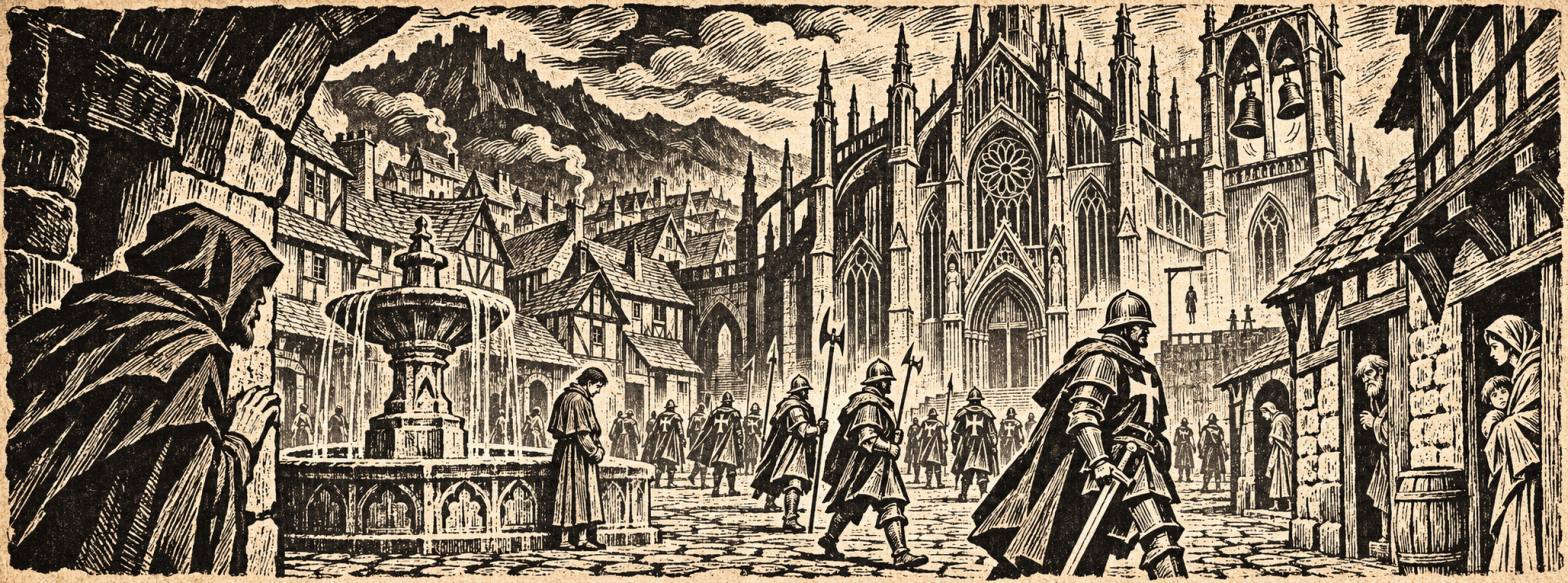
The first lay beside the fountain. Witnesses saw the Legion hold his head beneath the water until he ceased to struggle, then cast him upon the stones. The other was taken away alive. He was later found hanged by the Caspian Cathedral, his body bearing marks of torture. I cannot tell you what was asked of him, nor what he may have answered. Let any lodging or passage known to him be left unused until we learn more.
I have not set their names upon this sheet. The bearer knows them.
Before the drowning, the yellow-bearded captain addressed the square. He made particular mention of the black ribbons about their wrists and threatened any who gave shelter to our people or carried their words. Those questioned agree upon the substance of his warning. Even the giving of bread was named an offense.
Yet this business was concluded before the alarm. The bells were raised for other men.
Reports place a company of mounted strangers in the market that morning. They wore travel-stained cloaks and passed through without declaring themselves. A washerwoman recalls directing one of them to the barber-surgeon beyond the canal. Whether they sought aid for sickness or a wound, she could not say.
It was near that crossing that the Legion stopped them.
The officer there has been named as Barac. Witnesses describe soldiers barring the farther end of the bridge while others closed upon the riders from behind. There was some exchange of words, but we have no account of it upon which I would have you rely. No witness questioned stood near enough to hear the whole.
What followed was plainly seen.
One of the strangers drove his horse into the line before him. The others followed, and swords were drawn upon the bridge. A Legionnaire fell into the canal during the struggle. One account has him wounded before he fell; another says his horse threw him against the rail. I cannot establish whether he survived.
The company broke through.
This was no quiet flight thereafter. They rode into a street crowded with hawkers and carts, scattering wares beneath the horses. Barac’s men pursued them. At the mouth of a lane, one of the fugitives was seen cutting the bindings of a timber load. The wood fell across the road, checking the foremost horses and delaying those behind.
The timbers were still being gathered when our man passed. Of that part of the account there is little doubt.
Then came the alarm, the shutting of doors, and the mist.
Several witnesses remarked upon how swiftly it gathered. The morning mist had been lifting when the strangers entered Battenridge, yet now it thickened in the lanes until men could scarcely see whom they followed. Torches were lit along the quays of Lake Orvain. Those watching from upper windows lost sight of the pursuit below them.
There is already talk of sorcery. I have no proof to send you, only agreement that the change was sudden. Whether the strangers had any hand in it, or merely profited by its coming, remains unknown.
They were next reported crossing the square before the Caspian Cathedral. An arrow was still stuck in the gallows there. The riders continued toward the rising streets beneath the castle, with the Legion close behind.
Beyond this point, the accounts become less certain.
Horses were heard upon the road to the castle. Soldiers followed, shouting that the fugitives were making for it. Later, men of the Legion were seen searching the upper terraces on foot and trying doors. We cannot yet say whether the company divided, abandoned its mounts, or found shelter among the houses.
No witness known to us saw these strangers taken. Neither have we sufficient grounds to declare them free of the city. They appeared to have vanished with the queer fog.
Of their allegiance, we know still less. None reports a banner, and no name has been reliably given. Their horses, weapons, and conduct suggest men accustomed to arms, but that alone tells us little. They may have entered Battenridge upon business wholly apart from ours.
I therefore counsel that we make no claim upon their deed. The Legion will be eager enough to bind every drawn sword to Black Mountain without our helping them. Nevertheless, a company has met its steel, broken its line, and caused its officers to raise the city against them. Such men warrant inquiry.
We shall continue it with care. The captain’s threat in the square has done its work, and the sight of our dead has done more. People who will speak of overturned carts fall silent when asked to describe the riders. Whether they fear punishment for having watched or wish to conceal something they saw, I cannot yet judge.
I ask also that provision be made to recover our two men, should an opportunity arise. They were good, loyal soldiers and deserve a resting place in the hallowed ground of our beloved mountain. Those who undertake their recovery must have no knowledge of our present lodgings. Until we learn what was taken from the man hanged by the cathedral, we must reckon with the possibility that the Legion waits for someone to claim him.
Let their names be kept at Black Mountain, whatever may be said of them here.
I shall send again when I have firmer word of the strangers. For now, know this: the bells were not raised for the men at the fountain. Those men were already in the Legion’s hands.
The men it sought afterward had drawn swords and ridden through them.
Your faithful servant in Battenridge.
From the world of Sylvanus: Swords and Sons, book 2 of the Blood and Banners series.
Discover more from Author Scott Austin Tirrell
Subscribe to get the latest posts sent to your email.
