From the Governor of Battenridge to Grand Marshal Astros, concerning a tempest upon the southern road.
To the esteemed Grand Marshal,
I know well that the rooting out of dissenters, troublemakers, and those who still nourish rebellion in Battenridge leaves you little leisure for other matters. Were this account concerned only with spoiled grain and broken timber, I would leave it to those charged with assessing such losses. The queerness of the late tempest, however, and the disquiet it has stirred among the country folk warrant your attention. I submit these findings to your judgment, should you deem them worthy of being laid before His Imperial Majesty.
I have taken statements from householders, field laborers, and men traveling the road from Mosshaven and Eldenspire. None stood in the worst of the tempest and remained to give testimony. What follows has been gathered from those who watched its approach from shelter, together with the findings of men sent out after the waters fell.
The accounts agree that the wind failed and grew hush in the late afternoon. The wheat stood motionless, and the air heavy. Towards sunset, those accustomed to the country recognized what they call the Wasteland’s breath and brought their beasts under cover. Several speak of a bitter smell upon the first gusts, likening it to old mortar or water drawn from a long-disused well.
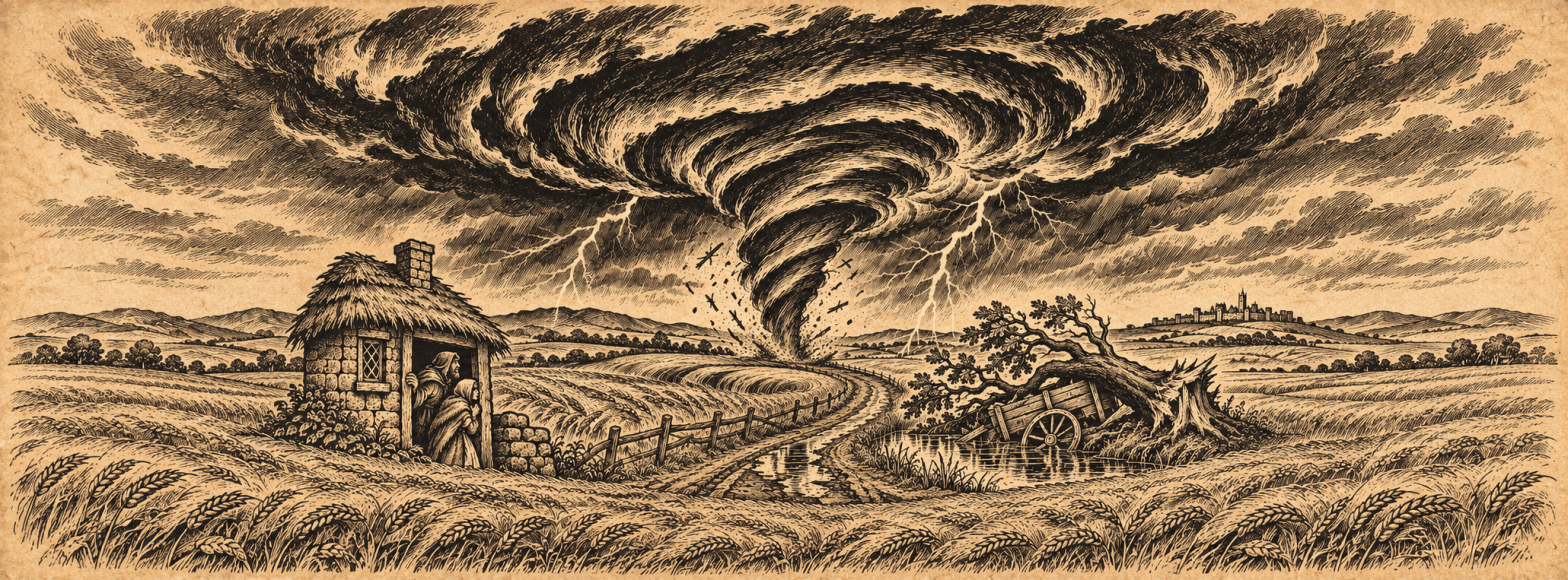
A darkness then rose in the east, in the quarter of the hills toward Eldenspire. It advanced with great speed. The remaining daylight took on a copper hue, and horses which had stood quietly at their tethers began to pull and strike, and cattle lay in the fields.
The first wind was hot, but it was soon replaced by a cold blast that brought rain so heavy that those looking out their doors could no longer distinguish the road.
As you know, these parts are well accustomed to strong spring storms, but it is the whirlwind within this tempest that chiefly concerns the witnesses.
Two householders, questioned apart, described a dark column descending beneath the clouds. One watched from the lee of a stone outbuilding; the other through a shutter which he afterward dared not open again. Both say that earth and broken matter rose within it. Neither could discern all that it carried. One thought he saw a wheel lifted above the fields, the other, a body in red robes, but would not swear to it.
A third witness saw only its lower portion passing beyond a rise. He described the wheat vanishing beneath a turning wall of rain and soil. The noise, he said, continued without pause, so that thunder could scarcely be distinguished from its roar.
There were repeated strikes of lightning near the road. Those watching could not see what was struck. They knew only that each flash showed the same stretch of country, while the fields nearer their own dwellings lay in comparative darkness.
By morning, the road was deeply scoured, and its ditches choked with mud and wreckage. An oak had fallen across a wagon, breaking its frame. It is not known what happened to its driver, but a horse was killed. Farther along were scorched fragments of timber, scattered provisions, and the remains of another draft horse. A great stone had come down from a ridge, crushing a rider and his mount beneath it.
The rider has not been identified.
A second man was recovered farther down the watercourse, caught where branches had gathered against the bank. His injuries were considerable, though whether inflicted before he entered the water or during his passage through it cannot now be determined. Neither man was known to those who helped recover him. Their clothing and such effects as remained have been kept for examination by the Legion if it should so choose.
We cannot yet reckon the full number lost. There was wreckage enough to suggest that travelers had been overtaken, but no survivor has presented himself to give an account. Some may have escaped with what horses and goods they could gather. Others may lie beneath the silt or have been carried beyond the ground already searched.
I have ordered that the dead be afforded burial, with their graves marked should kin come seeking them.
You will understand that such destruction breeds fearful explanations. The people of these fields have endured hard weather before. What troubles them is the narrowness of the worst damage. Men whose crops were beaten flat can point to ground beyond where the stalks remain standing. One holding lost little more than thatch, while a short distance away sound timber was torn apart.
The common saying is that the storm was seeking something upon the road.
I have required those repeating this to name the person from whom they heard it. Thus far, each account leads to another frightened neighbor. No man has furnished proof of a hand directing the weather. There are whispers that witchfolk may lurk in the forgotten corners, but as we know, the good works of His Imperial Majesty have vanquished such wickeness from the land.
There is also testimony concerning lights seen after the tempest had passed. These were described as blue and green, low over the wet fields, appearing and failing again beneath the clouds. One witness supposed them to be lanterns carried by men searching for their beasts. Another maintained that no lantern burned in such colors.
None went out to learn the truth of it.
By the following morning, the lights were being called witch-fires; again, I suspect this is the locals’ superstition, but even if simply countryfolk fear, it warrants your attention, if only to correct their errant ways. Eldenspire and the ruins of Lysena are named in every telling, though those most certain of their influence have ventured near neither. I have forbidden accusations against any living person upon such grounds. Fear has already cost us labor in the fields; it must not be permitted to supply victims as well.
Nevertheless, I would not dismiss the whole matter as the foolishness of country folk. The whirlwind was seen by more than one credible witness. The dead and the shattered wagon are before us. Whatever judgment is made concerning its cause, the violence of the visitation cannot be doubted.
I therefore ask that men learned in such matters be sent to examine the ground, and that a small escort accompany them. Should such an inquiry require authority beyond our own, I leave it to your discretion to seek His Imperial Majesty’s pleasure. The witness statements and an account of the recovered effects shall be made ready for your seal.
Meanwhile, the road must be cleared and its safety established before merchants begin taking longer ways to avoid it. The neighboring households have been instructed to report any additional lights, missing persons, or recovered goods from the fields.
They have obeyed the instruction to search by daylight.
I have not yet found men willing to remain there after dusk.
Under my hand and seal,
Estefen Cornwall
The Governor of Battenridge
From the world of Sylvanus: Swords and Sons, book two of the Blood and Banners series.
Discover more from Author Scott Austin Tirrell
Subscribe to get the latest posts sent to your email.
