Last week, I was on a stay-cation, which, for me, apparently means spending most of my “relaxing” time finishing writng a novel.
I had been aiming for 2,000 words a day as I pushed toward the end of Sylvanus: Swords and Sons, but once I could see the finish line, that goal pretty much went out the window. On August 14, the manuscript stood at 103,256 words. By August 19, it had reached 122,046. Four days later, on Sunday, August 23, I finished the first draft at 136,765 words.
That means I wrote more than 33,000 words in nine days (avg. 3,667 a day).
It was one of those stretches where I was so immersed in the story that there wasn’t much time for anything else. I grew a scruffy beard and perhaps earned a little scolding from my wife. I would finish a scene, realize I needed to know something oddly specific, disappear down a research hole, find the answer, and go right back to Lucardia.
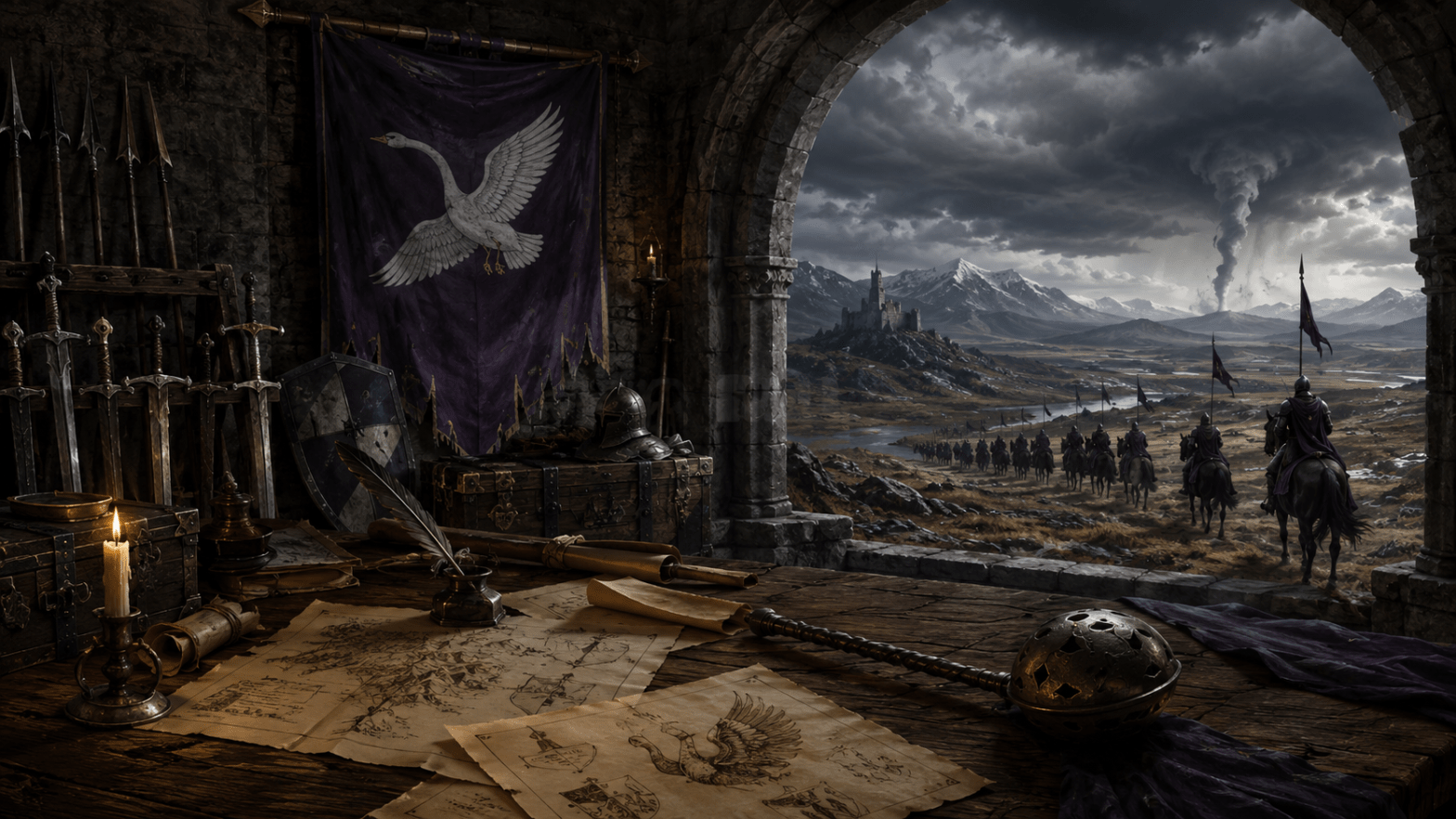
Which is how, over the course of finishing a fantasy novel, you wind up asking questions like: Where did medieval castles keep their weapons (big castles had armories, but for the rest they were stored close to where they were needed, such as gatehouses, but more often than not they were just put wherever they could fit)? What are those things filled with coals used to warm beds called? Are there tornadoes in Europe, and what would they have been called in medieval times? What would two hundred mounted knights actually need in order to travel and fight as a functioning force?
Fantasy is sometimes described as a genre in which the writer can simply make things up. Technically, that’s true, and I do that a lot. Although Lucardia is roughly based on medieval northern Europe, it isn’t medieval northern Europe, and I don’t have to reproduce history exactly. But I’ve always found that fantasy feels more convincing when the invented parts rest on something solid. If two hundred Knights of Norn ride into the Northlands, they don’t exist in a vacuum. That isn’t necessarily a northern medieval Europe problem. It is one of logistics.
Suddenly, I am no longer writing about heroic knights riding north. I am trying to determine how many additional people have to accompany those knights so that half of them don’t arrive hungry, horseless, and wearing broken armor. Knights of the European tradition would typically have several mounts, and they would not travel on the horse they would ride into battle on. That horse would be large to support the additional weight of armor (a destrier or, in my world, a Luenwell destrier), and would have been kept fresh. Riding a tired horse into battle would have been stupid.
Then you have all the people required to make that knight presentable in battle. The Knights of Norn are a bit different in that they are not landed gentry from the period but rather a religious fighting order, so their support is more institutionalized. They would still have a huge support network. As a base, I grouped them as 3 squires for every 4 knights, so an additional 100-150. But then there are grooms, farriers, armorers/smiths, wagoners, cooks/servants, healers, clerks, and priests. A force of roughly 200 fighting knights would need roughly another 275 people, bringing the expedition to around 475 altogether. Once warhorses, riding horses, remounts, pack animals, and draft animals are included, the column could easily involve 650 to 700 animals as well. That is a loud, stinky mass that is not easily hidden and changes the whole way of writing about them.
Other questions are much smaller. Someone is cold at night. Fine. I know that they would have used long-handled metal pans filled with hot coals passed between the sheets before someone climbed into bed, but I wasn’t entirely sure what they would have called them. It’s a tiny detail, perhaps only a few words in the finished novel, but I wanted to get it right. Bed warmer was an unimpressive result of my query.
Then there was the tornado.
Tornadoes certainly aren’t the first thing that comes to mind when thinking about a medieval Europe-inspired world, but they happened. That was the first question. So no stretch of the imagination there. The problem then becomes what someone living in a world without modern meteorology would have called it. I was pretty sure they wouldn’t have used a Spanish word, and I was right. The word tornado didn’t appear in English texts until the late 16th century, when it was used to describe the storms Spanish explorers encountered in the Americas (it was also used to describe hurricanes). Before this, a “tornado” in English-speaking Medieval Europe would likely have been called a whirlwind or just a tempest. Lucardia is set in the late-Medieval period, and there is no Spanish, so the use of “tornado” didn’t sit right with me, so I used “whirlwind.”
And sometimes history can’t help at all.
At one point, I realized I needed to know what appeared on Sylvanus’s standard (the series title is Blood and Banners after all). Koen already has the wolf’s head associated with him (there is a whole story behind that), but Sylvanus needed something distinctly his own. Eventually, I settled on a white swan in flight against a purple background. Purple and Gold were his mother’s Anworth Kingdom’s colors, and swans often appear on the lake next to Runemaul (Lake Constance). Swans are elegant, graceful creatures, but they are also fierce when protecting their families. Although there was no historical answer to uncover because Sylvanus never existed, the decision still had to feel as though it belonged to the same world as everything surrounding it. Swans did appear on medieval standards, so problem solved.
That is one of the strange things about writing my ninth book set in Lucardia. The more I write about it, the less freedom I have to simply invent things.
The world has accumulated history. Kingdoms have customs. Armies operate in particular ways. Families have symbols. Religions have traditions. Roads connect places I’ve already described, characters remember events that happened in other books, and something I casually established years ago can suddenly become very important when another character arrives in the same place. When I talk to my wife about it, she says, “No wonder your head is so big!” (my head is proportional to my body, by the way).
Lucardia has become large enough that I increasingly find myself researching my own imaginary world alongside the real one; luckily, my past self has kept detailed notes, spreadsheets, timelines, and maps.
The first draft of Sylvanus: Swords and Sons is finished now, and I’ve moved heavily into editing. As expected, the manuscript is already shrinking rather than growing. The 136,765 words I finished with on Sunday have already become 134,067 as I tighten scenes, cut repetition, and begin figuring out what actually deserves to survive into the final book. Some of the details I researched will be cut, but that’s okay because the knowledge can always be used in the future, and there will undoubtedly be plenty more strange questions before I’m finished with this epic.
For the moment, though, I know where the swords are stored, how the beds are warmed, what follows two hundred knights down the road, what Sylvanus carries on his banner, and what people in Lucardia might make of a funnel cloud dropping out of the sky.
Apparently, that counts as progress—it certainly counts as enrichment.
Cheers!
Discover more from Author Scott Austin Tirrell
Subscribe to get the latest posts sent to your email.

Fun fact: While I was in London back in 2006-2008 a tornado touched down a few blocks from where we were living. Dismantled part of a row of houses and threw stuff around, no deaths or injuries. We were really surprised as we hadn’t realized tornadoes were a thing in London…… It turns out, according to Claude: “The UK has the highest tornado density per unit area in Europe (most sources cite this specifically), though nearly all are weak.”
LikeLike
I suppose for my story, being fantasy, it really didn’t matter. I can just say Lucardia has tornadoes, but it got my brain wondering, so of course I had to research it 😉
I’ve had several run-ins with tornadoes, unfortunately. When I was a boy, I was camping in a cow field in the Berkshires with my friend and his mother when we were woken in the early morning by a thunderstorm. We looked out of the tent and saw the cows running back and forth across the field, and the sky was dark and swirling. We huddled under a small grove of trees and prayed. It was terrifying. Luckily, we didn’t see the actual funnel, but there was a lot of damage all around, with roofs torn off houses and trees down across the road. Then, in 2010, one carved a path through western Massachusetts, destroying the center of my hometown. It ripped the steeple off of the church I went to when I was a boy and destroyed one of the elementary schools I went to. Even now, you can still see the path through the woods, especially on Route 20 through Brimfield, MA. Then, just a few years ago, one hit near my current home, which is pretty close to Boston, and damaged several houses. They were all considered freak storms, especially the one that hit my hometown. Yahweh must be angry with me 🙂
LikeLiked by 1 person
Why Yahweh? The Greek god Typhon would be a better match. Trying to get your attention, maybe, and leaving calling cards that would do so…. but you were never harmed right? And you no longer when to that church or that school….. Maybe he will be pleased that you have let him roam about in Lucardia now…
LikeLike
Hmm,not sure why you associate tornadoes with Yahweh? Thunderbird is the closest divine match, I think, although (quick research) ah, even better! The Greek god Typhon — a monstrous, storm-associated figure whose name is the root of “typhoon,” often linked to violent, chaotic windstorms. AND…. in every case you were passed by even though nearby structures were damaged. So maybe Typhon actually is fond of you? Came by to visit and left a few calling cards sure to get your attention but careful never to harm you directly.
LikeLike
Yahweh was a storm deity before becoming a monotheistic god: https://en.wikipedia.org/wiki/Yahweh.
LikeLiked by 1 person